Rob sums up a common trolling technique:
When I challenge white supremacy, someone protests, “You’re ignoring class oppression! You’re not intersectional enough!”
When I write about global warming’s effects on coral reefs, someone replies, “Why don’t you mention deforestation or plastic pollution?”
When I speak up about police brutality, someone yells, “Why don’t you talk about domestic violence or human trafficking?”
When I share a piece about the suffering of factory-farmed pigs, a commenter retorts, “What about the children starving in Gaza?”
When I celebrate women reclaiming their bodies from centuries of shame, someone says, “But what about men’s mental health?”
When I critique corporate greed in Silicon Valley, a critic says, “But Wall Street is worse! Why ignore them?”
When we speak, we carve a small sculpture out of the infinite. Every utterance is a narrowing, a slice of attention through the great blooming, buzzing confusion of existence. To say anything is to choose, and to choose is to leave out.
.
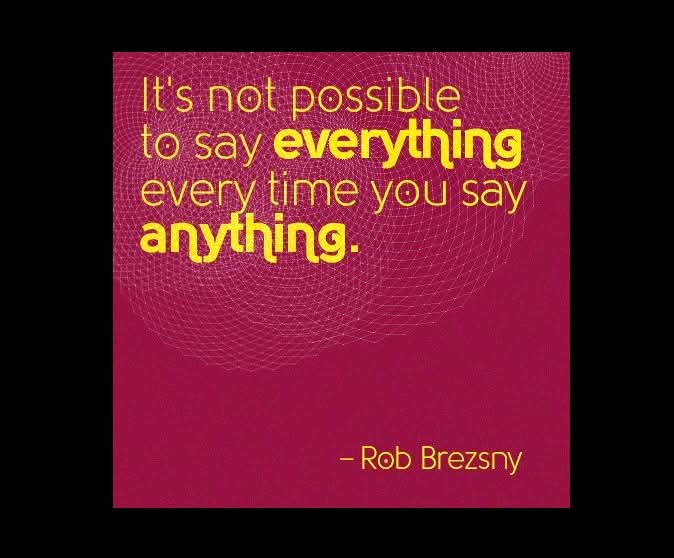
“It’s not possible to say EVERYTHING every time you say ANYTHING” is both an epistemological truth and a spiritual hygiene principle. It reminds us that focus is not exclusion; it’s the price of coherence.
.
If we try to mention all suffering every time we name one, all beauty every time we praise one, our speech collapses under the weight of impossible inclusivity. The result isn’t compassion but paralysis.
.
Our culture’s moral discourse often mistakes breadth for depth. Many believe that mentioning every possible angle proves fairness or intelligence.
.
But in truth, deep justice work and deep artistry depend on specificity. Each act of attention — to a person, a wound, a species, a joy — honors the sacred particular. To name one injustice is not to erase the others; it is to hold one glowing fragment of the world’s pain and say, “I see you.”
.
The quote also protects against a subtle form of ego inflation. The fantasy that one could ever speak for everything is the voice of the inflated savior or the anxious perfectionist.
.
Real wisdom, like real love, knows its limits. It trusts that other people will carry the stories we cannot. It believes in the ecology of attention — the idea that when each of us tends one corner of the garden with sincerity, the whole Earth is nourished.
.
So when critics cry, “But what about all the other injustices?” the answer is not defensiveness, but clarity: “Yes, they matter too. And right now, I’m speaking to this one.”
.
Focus is not neglect. Focus is fidelity.
.
.