That was my knee-jerk reaction. However, I do not want to limit posts in any way whatsoever. I think you are right to a point; thoughts can be like bottle rockets without the bottle. From what I understand, learning is a trigger to create another molecule in your genome. I just received an offer to download a post PH.D. paper describing what else is necessary for yourself to signal a new molecule of DNA. I’ve scanned the paper; it includes scientific values for scientists to use to write formulas to create new DNA applications. I am happy to post the document on what else I can find that makes DNA which you are.
When you mentioned “thoughts” as more to who you are than just DNA, are you wanting to find an entry point for God? because that is fine if you are.
The advantage of using DNA is that it is easier to manage who you are than the “body, mind, soul” elusive attempts to upgrade yourself.
Again, these are not new ideas; they are just new to us. My theory is how to use these outstanding gifts of science DNA to benefit ourselves.
True, but a more complex brain can create more complex thought patterns that would be impossible for smaller networks in other hominids or animals in general.
AFAIK, brains start very early with the emergence of neural networks that are able to process electrochemical data instead of just kinetic responses as in single celled Paramecium that has no brain or neurons, but does have a response reaction to external pressures.
Are you sure about that. It is known that learning and thinking creates new neuron growth and synaptic connections due to the dynamic properties of microtubules that actually cause neural growth.
DNA itself does not change except as a result of small errors in duplication during mitosis (also regulated by microtubules) or an occasional mutation that usually has a detrimental effect on the next generation. That’s where natural selection comes in.
Due to our ability to override natural selection, the human DNA is slowly degrading which is demonstrated by our increase use of artificially created pills and potions.
In the wild, natural selection results in the survival of the fittest to procreate. Over time the species get healthier and smarter. Humans only get smarter but in general, not better equipped to combat genetically inherited diseases.
Quite true, but the neurons need continued stimulus to grow and continue more complex thought. The baby can’t just born and not recieve nurturing from parents and other members of their human circle and expect continued growth. So this is where we have both nature and nurture. A baby without attention doesn’t thrive mentally and sometimes not even physically. There’s been studies on this with rhesus monkeys and finding abused and neglected human children. DNA by itself doesn’t do much after birth without human nurturing.
And that is the job of microtubules! Microtubules are the mechanism that copies the chromosomes and duplicates them in the daughter cell.
The Centrosome and Microtubule Organization
The microtubules in most cells extend outward from a microtubule-organizing center, in which the minus ends of microtubules are anchored. In animal cells, the major microtubule-organizing center is the centrosome, which is located adjacent to the nucleus near the center of interphase (nondividing) cells (Figure 11.39). During mitosis, microtubules similarly extend outward from duplicated centrosomes to form the mitotic spindle, which is responsible for the separation and distribution of chromosomes to daughter cells. The centrosome thus plays a key role in determining the intracellular organization of microtubules, although most details of its function remain a mystery.
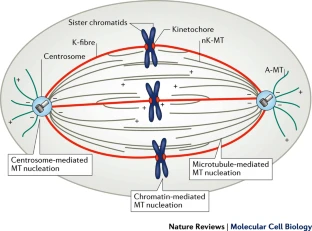
Figure 11.39
Intracellular organization of microtubules. The minus ends of microtubules are anchored in the centrosome. In interphase cells, the centrosome is located near the nucleus and microtubules extend outward to the cell periphery. During mitosis, duplicated (more…)

Whatever you or others may want to grind down to some granular level of discussion, just search your little hearts out. Whatever, any microcosm you ferret out is great, have at it. To me, at least right now all of that is minutia.
I just want to work on how people can make the low-hanging fruit of this fantastic discovery of the century, DNA, benefit them personally.
Exactly what I was trying to say above. I didn’t see this when I posted earlier.
We are learning how to use microtubules in controlling cell division and behaviors.
It might lead to a cure for cancer!
poinpath, I like your perspective.
I really recommend that you familiarize yourself with microtubules.
Consider, humans have trillions of dynamic microtubules inside neurons connected by 100s of trillions of synapses.
All of this incredible network is engaged in data processing that makes the entire human body the most sophisticated biological computer in the universe. It even has an evolved sentient self-aware consciousness. But humans are not the only creature blessed with extraordinary abilities…
Octopuses may be so terrifyingly smart because they share humans’ genes for intelligence
By Donavyn Coffey published 6 days ago
Genetic sequences called transposons help regulate learning.
This is a perfect demonstration how evolution selects for adaption to the environment.
Two intelligent Eukaryotic organisms evolved separately in two incompatible environments.
Then to think that every cell in ALL Eukaryotic life has microtubules in common, it begins to show the incredible variety and complexity of life on earth today, and that’s not counting all living creatures that are now extinct.
And all that was preceded by Prokaryotic life and that in turn was preceded by self-organization of biochemical polymers into replicating cells. Yet according to Robert Hazen, it is likely that all planets that have somewhat similar chemicals and ecospheres in common will have emergent life in some form specifically adapted to its environment.
You see, the universe is not fine-tuned for life, but rather life is fine-tuned to its environment.
Why don’t you share the link, or some key quotes, at least title and author?
I can’t image what you are talking about the creation of new molecule of DNA, everything I’ve read discusses replication of DNA.
But it sounds like you are trying to discuss experience creating DNA from scratch?
… or is that modifying DNA?
Either way what are you talking about? Can you share any references to learn about this?
Or is it your own discovery that you haven’t published yet?
The title of the author is a must, as well as the title of the alleged paper, because he can allegedly quote, but he could be pulling stuff out of his proverbial spot, which would make it his own alleged discovery that isn’t published or even peer reviewed.
I don’t understand the “received an offer” part. If it’s published, then it’s listed online. Also, you can ask author of a paper for a copy. No special invitation required.
DNA/molecules again non relevant questions

|### PDF By Nicolas Carels updates@academia-mail.com Unsubscribe|4:16 PM (4 hours ago)||
|
| — | — | — |
|to me
|

You read the paper Recombination in primeval genomes: a step forward but still a long leap from…. A related paper is available on Academia.
A history of genomic structures: the big picture
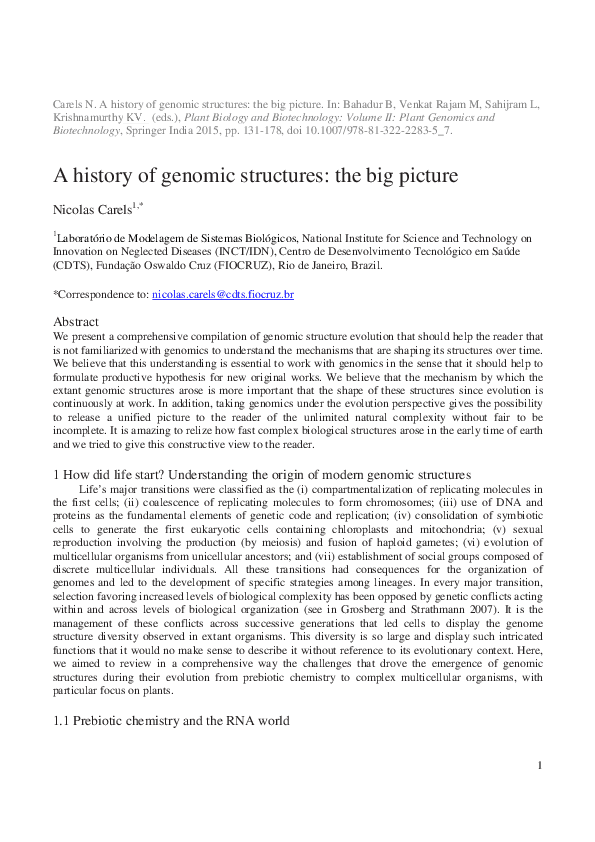
 Nicolas Carels
355 Views
View PDF ▸ Download PDF 
ABSTRACT
We present a comprehensive compilation of genomic structure evolution that should help the reader that is not familiarized with genomics to understand the mechanisms that are shaping its structures over time. We believe that this understanding is essential to work with genomics in the sense that it should help to…
read more…
Your recent reading history:
Synthetic protocell biology: from reproduction to computation - Carlos Rodriguez-Caso
Bootstrapping the Energy Flow in the Beginning of Life - Rob Hengeveld
The Concept of the Organism in the Philosophy of Biology - Catherine Wilson
First life, and next life - David Deamer
Reciprocal Linkage between Self-organizing Processes is Sufficient for Self-reproduction and Evolvability - Terrence Deacon
The Origin of Life: Chemical Evolution of a Metabolic System in a Mineral Honeycomb? - Tamás L Czárán
Recombination in primeval genomes: a step forward but still a long leap from maintaining a sizable genome - Mauro Santos
Cooperation: A key principle in the evolution of the universe -from Quarks to Quare Fellows - David Hookes
The origin of replicators and reproducers - Eors Szathmary
What is a CRISPR and what does it do?
CRISPR-Cas9 is a unique technology that enables geneticists and medical researchers to edit parts of the genome? by removing, adding or altering sections of the DNA? sequence. It is currently the simplest, most versatile and precise method of genetic manipulation and is therefore causing a buzz in the science world. Feb 8, 2022
Your genome is the complete set of genetic information in the cells of your body. It is like a recipe book that provides the instructions for who you are, and the recipes are your genes. Each gene provides a set of instructions for the protein molecules that make up your body.
Do you really want to know what’s lurking in your genome?
[image]
theconversation.com/do-you-really-want-to-know-whats-lurking-in-your-genome-…
BioMed Central on TwitterBioMed Central on Facebook
On Biology
What can we learn from our genomes?
The human genome is full of untold stories about our evolution and history. In the post-genomic era, we are constantly developing more advanced tools to reveal the secrets of our past. In this blog, I’ve looked at just a few of the fascinating areas of human evolutionary genomics.
Sam Rose 13 May 2015

Recent biotechnological and bioinformatic advances that now enable us to read and analyse genomes of modern and even archaic humans have already led to fascinating insights into human evolution. Human demographic history as written from a limited number of genetic markers has partly been confirmed by the first genome-wide studies, but also due to the immense power of genomic data.
The female effective population size has been larger than the male effective population size throughout the history of modern humans.”
Analyses of modern and ancient human genomes not only allows comprehensive investigation into where and when our ancestors originated and migrated, but also how they adapted to environmental factors that were different throughout space and time. Genomic analysis of ancient DNA has already identified archaic human forms that remained unrecognized using classical approaches, and more are expected to be revealed, suggesting that our modern and archaic ancestors had mixed.
Encouraged by the success of a special article series in affirmation of Sir Alec Jeffreys’ discovery of DNA fingerprinting and its impact on science and society, Investigative Genetics has published an article collection paying tribute to a new branch of investigative genetics by providing a platform for the rapidly emerging field of human evolutionary genomics. The series includes research and invited reviews, and is still open for submissions.
In one review Irina Pugach and Mark Stoneking provide genome-wide insights into the genetic history of human populations in Southern Africa, India, Oceania, South East Asia and the Americas, highlighting some of the stories that have emerged.
Another review in the series by Michael Hofreiter and colleagues looks at how recent technological improvements have rapidly transformed ancient human DNA research to become a central component of modern anthropological research. With human genomes dating back 45,000 years having now been sequenced (and even older for other species) this is indeed a very exciting time for ancient DNA research.
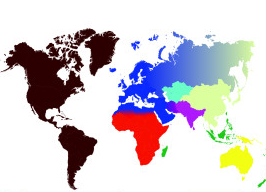 It’s hard to not be intrigued about where we originally came from, and now there are many tools that can be used to extrapolate this information from individual genomes. These data, together with what historical information we know, can then provide a picture of how and where our ancestors lived. Looking at these approaches, Andreas Wollstein and Oscar Lao discuss the most widely used methods in population genetics for evaluating individual genetic ancestry.
Mitochondrial DNA, which is maternally inherited and hence can teach us about maternal ancestry, has been a widely used tool in human evolutionary and population genetic studies over the past three decades. In a further review, Toomas Kivisild provides an update on mitochondrial genome sequencing for the assessment of female-specific aspects of human demographic history.
The series also includes some exciting research articles, including a comparative mitochondrial and Y chromosome DNA study by Sebastian Lippold et al. that found the female effective population size has been larger than the male effective population size throughout the history of modern humans.
With such a fast-moving field as human evolutionary genomics, there is much a feeling of “what’s next?”. Sequencing a million-year-old genome will be a proud milestone – to date the oldest genome sequenced has been a 700,000-year-old horse. As technology continues to improve and read DNA that was previously inaccessible, who know’s what our genomes will tell us next.
Topics:
Tags:
archaeologyevolutionary biologygeneticsgenomics
SHARE THIS POST
[
< PREVIOUS POST
Microbial forensics: It’s not just fingerprints that can be left behind
12 May 2015
](On Biology Microbial forensics: It’s not just fingerprints that can be left behind)[
NEXT POST >
Correct or retract?
15 May 2015
](On Biology Correct or retract?)
And here microtubules are critically important.
Microtubules Are Essential for Mitochondrial Dynamics–Fission, Fusion, and Motility–in Dictyostelium discoideum
Here we present data suggesting that microtubules are the predominant cytoskeletal element for moving and distributing D. discoideum mitochondria. We show an almost complete loss of motility in cells treated with nocodazole as well as the relaxed and more distributed clusters found in cluA − cells with disrupted microtubules. Additionally we and others have observed a small population of mitochondria that associate with the microtubules (Vlahou et al., 2011). Finally work by Vlahou et al demonstrates that mitochondrial distribution is dependent upon intact microtubules (Vlahou et al., 2011).
We also demonstrate that microtubules are essential for mitochondrial fission and fusion. It has not yet been teased out whether disruption of fission and fusion in these cells prevents motility or if motility must be functional for fission and fusion to take place. It has been suggested that blocks of fission and fusion will inhibit motility and distribution. Incomplete fission can result in a tangle of interconnected mitochondria and incomplete fusion can result in mitochondrial aggregates, thus motility’s effect on the processes seems clear (Chen and Chan, [2009]
(Microtubules Are Essential for Mitochondrial Dynamics–Fission, Fusion, and Motility–in Dictyostelium discoideum - PMC)).
On the other hand, it has been shown that loss of Miro, which inhibits motility, subsequently inhibits fusion (Cagalinec et al., 2013). It is logical to assume that motility facilitates fission and fusion as at least one mitochondrion must move toward another for fusion to take place and once divided the organelles must move apart to remain separate. Either way it is apparent that mitochondrial dynamics are intimately linked to motility and in D. discoideum, as suggested by our data, regulated by microtubules.
more…
Interesting papers, I don’t understand the detail, but followed the outlines.
But I don’t get the connection between that content in those papers with this comment
or
or
Can you explain how they are related?
This conversation is about everything from potatoes to puppies including humans, who owe their born appearance and characteristics to DNA. (that is not debatable)
Humans have a unique opportunity to use this scientific discovery of the century to understand better how to benefit themselves. That’s it, not selling anything; it’s already yours; you are just unaware. My theory is, that if a person harbors a spec of the notion of monotheism, that person will remain unable to understand who and what they are and especially what they are supposed to be doing; they will remain unaware of their biological self.
Stop with the scientific questions. I am not a scientist; I am a humanistic theorist. I am also sorry that I can’t explain better.
No, that’s incorrect. DNA is a biochemical polymer that contains the blueprint of growth instructions. It is a purely chemical coding system that has no memory of living experiences. As I said any mutation of the DNA is usually detrimental to the physical structure of your body.
The fusion of 2 chromosomes in our human ancestor is one of those rare instances of a “beneficial mutation” rather than a gradual evolutionary result of natural selection, but only resulted in a bigger brain capable of processing more data and possessing greater memory storage capacity.
While it is true that individual cells have short term memories which are more kinetic than abstract, long term memories are stored in “pyramidal neurons” in the brain and those are what the brain accesses when “thinking”, i.e. processing incoming sensory data and comparing it to data stored in memory for pattern cognition.
I don’t remember if I have recommended Anil Seth in context of “brainfunction” and the limitations of certain hard wired cognitive algorithms in the brain caused by evolved DNA growth instructions.
Let me show you what I mean;
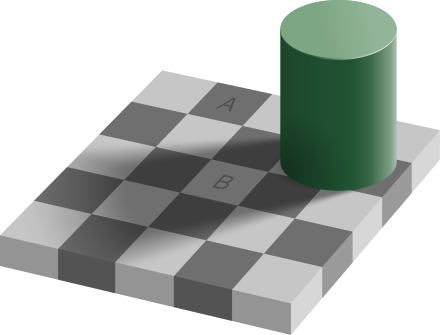
Note that A and B are the exact same shade of gray, but no matter how hard you try, your brain does not allow you make that association.
Now look at this;
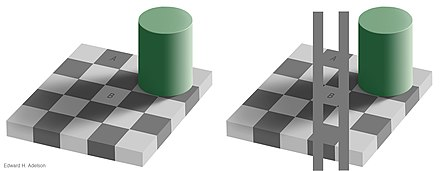
If I join the 2 squares it becomes apparent that they are the same shade, but if I return to figure 1, they seem to be different again and no matter how hard you try your brain will not allow you to see them alike.
This mental conversion is caused by billions of years of looking for danger in the shadows and “brightening” contrast to spot where a predator might be lurking.
This is like a computer program that takes a shadowed color and brightens it, and there is nothing you can do about it.
This is just one of the great examples of evolution for adaption to the environment.
Contrast effect
The contrast effect was noted by the 17th century philosopher John Locke, who observed that lukewarm water can feel hot or cold depending on whether the hand touching it was previously in hot or cold water.[15]
In the early 20th century, Wilhelm Wundt identified contrast as a fundamental principle of perception, and since then the effect has been confirmed in many different areas.[15] Contrast effects can shape not only visual qualities like color and brightness, but other kinds of perception, including the perception of weight.[16]
Whether a piece of music is perceived as good or bad can depend on whether the music heard before it was unpleasant or pleasant.[17] For the effect to work, the objects being compared need to be similar to each other: a television reporter can seem to shrink when interviewing a tall basketball player, but not when standing next to a tall building. Furthermore, the contrast effect has been argued to apply to foreign policies of states. For example,[18]
Yes, I kow that. And I also know there is so much more. BTW, I really like your presentation of search, copy and paste, nice job.
This is uninteresting minutia to building a lifestyle for those who know they are members of the evolving human species, (do you know or believe that you are a member of the human species?)
Infants are born with all the blank (whatever you want to call this chemical) to last their lifetime for storing lessens learned. (this is the memory I am referring to.