Yes they do. I’m too busy to respond to the rest. Maybe this weekend. But that’s the long and short of it. They do. I do. But you find arguments everywhere. You demand acknowlegment of your comments about the present while people are teaching history. You claim Kantian ideas of time and space need to be updated with evolutionary thinking, but you don’t say how that thinking changes what the symbol “4” means or how we arrived at it.
Guess you haven’t noticed that I’m focused on discussing our relationship with the knowledge we possess, not in proving 2+2=4.
Heck we still have endless discussion about God, and all the endless scriptures people have written, as if it were something out there.
That’s not being corrected in the public arena and I find that irritating. Lordie I have a philosophy professor telling me that my writing is confused because I don’t differentiate the “Idea of God” from the “Being of God” (which I actually do! The Being of god is an element of our Mindscape.).
Then he goes silent, deep silence, when I ask him to explain: “How an assumption of God becomes a Being of God?”.
Here’s the deal; stop hijacking my threads. I was talking to inthedarkness and you had to comment with your favorite comment. Stop doing that. I asked you then how evolution related to time and space and you couldn’t answer then and now you are admitting it’s not what you are even taking about.
Stop hikacking my threads and I’ll leave you alone on this thing of yours.
Physical Reality / Human Mindscape divide.
But it is in the interaction between Mind and Reality that makes conscious self-reference possible.
But then would it not add “relativity” (POV) to the equation?
This is my thread 
In the previous instance I was also trying to express some thoughts to inthedark.
And that wasn’t actually your thread either matioesperante started “Awaken To Reality”
Furthermore, I was responding to inthedark since I can relate to some of his frustration and wanted to offer another approach that might make more sense to him, at least give him something to chew on.
Please don’t present a video if you don’t want critique. Or at least put up a warning:
This video is not up for discussion.
Sure ?
I don’t really understand what you are asking.
Relativity, as in recognizing space and time?
Sure.
Where do you see a problem?
PS.
Physical Reality ~ Human Mindscape divide.
(Don’t us a backslash. “~” there’s for a reason for it. Which is probably where your POV resides.
I’m not going to go down a tit for tat over the definition of hijacking. You can discuss if you want, but like I say to everyone equally on this forum, if you say something, back it up with logic and data. You tried to critique a great philosopher, then couldn’t back it up.
In case you forgot, this is one of your more flagrant comments
is spoken within the now, displaying no appreciation for the fact that our physical body is the product of countless generations learning to deal with “Time and Space” and the facts of physics upon this planet. It’s not something every new baby needs to acquire, its body has already acquired extensive learning that philosophers can’t imagine.}
[quote=“citizenschallengev4, post:26, topic:10593”]
I don’t really understand what you are asking.
Relativity, as in recognizing space and time?
Sure.
Where do you see a problem?
No one sees reality as it is. Our individually subjective reality is that which we share and relatively agree on.
PS.
Physical Reality ~ Human Mindscape divide.
(Don’t us a backslash. “~” there’s for a reason for it. Which is probably where your POV resides.
Yesss… I like that “~”
That highlights the difference that I’m trying to enunciate.
Our senses “see” (receive) physical reality AS IT IS!
Then those senses (body/brain) process those signals into our “perceptions” of the real world around us.
We don’t make up reality - we perceive reality best we can according to our body plan.
It sure would be nice if you share the source, I tried finding it but apparently it’s not in this thread - would love to see full context.
The only concession I could make at this point is “No” should have been something more like seldom, or rarely. (Though, Evolution does get presenting like a postcard then forgotten in the next sentence.) Beyond that the full context of that quote would be helpful in responding to your charge.
Thank you, it’s exactly these sorts of overlooked subtle details that I’m striving to underscore
At your 23:30 timestamp
[quote=“citizenschallengev4, post:29, topic:10593”]
Our senses “see” (receive) physical reality AS IT IS!
That doesn’t hold true. Physical reality is AS IT IS, but what we see is subjective and relies on sensory acuity and the fixed memory of what it is we are seeing.
Then those senses (body/brain) process those signals into our “perceptions” of the real world around us.
And in the processing, each brain has its own unique “sensory experience” depending on the brain’s configuration and interpretation.
We don’t make up reality - we perceive reality best we can according to our body plan.
Yes, I agree, but we do construct our own reality. Hence the “unreliability” of subjective experiences.
23:10
ANIL SETH
How your brain invents your “self”
23 minutes 10 seconds
Who are you, really? Neuroscientist Anil Seth lays out his fascinating new theory of consciousness and self, centered on the notion that we “predict” the world into existence. From sleep to memory and everything in between, Seth explores the reality we experience in our brains – versus the world as it objectively might be. (This talk and conversation, hosted by TED science curator David Biello, was part of a TED Membership event. Visit Become a TED Member today. to become a TED Member.)
](Anil Seth: How your brain invents your "self" | TED Talk)
21:40
DONALD HOFFMAN
Do we see reality as it is?
21 minutes 40 seconds
Cognitive scientist Donald Hoffman is trying to answer a big question: Do we experience the world as it really is … or as we need it to be? In this ever so slightly mind-blowing talk, he ponders how our minds construct reality for us.
](Donald Hoffman: Do we see reality as it is? | TED Talk)
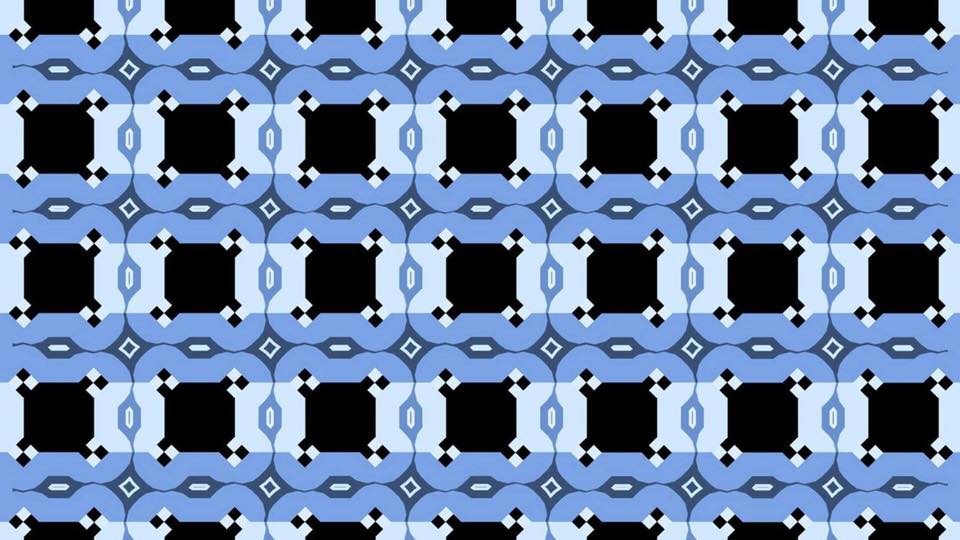
I’m completely flabbergasted that you quoted Hoffman here. What’s left of my spirit has left my body and is wondering if anything is real.
1 Like
Yes, “AS IT IS” is horizontal and those wave lengths are received au naturel by the eye. It is the brain that gets confused by the “differential equations” of the patterns.
An even more fundamental exampl of an optical “illusion” is found in the “checker board illusion”.

The regions marked A and B are the same shade of gray
proof
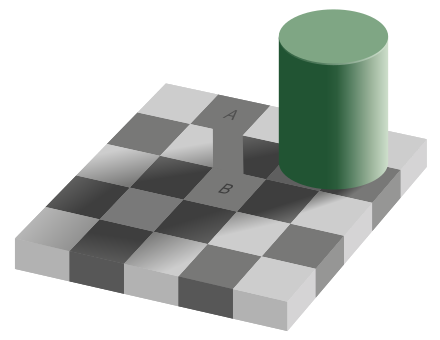
A region of the same shade has been drawn connecting A and B.
This illusion cannot be “experienced” as the same shade, even if you “know” the colors are the same . It is impossible to override the brain’s conditioning for a “survival advantage” in seeing B lighter than it is.
The brain NEVER gets raw data directly from the source! All sensory information is converted into electrochemical data that the brain can process.
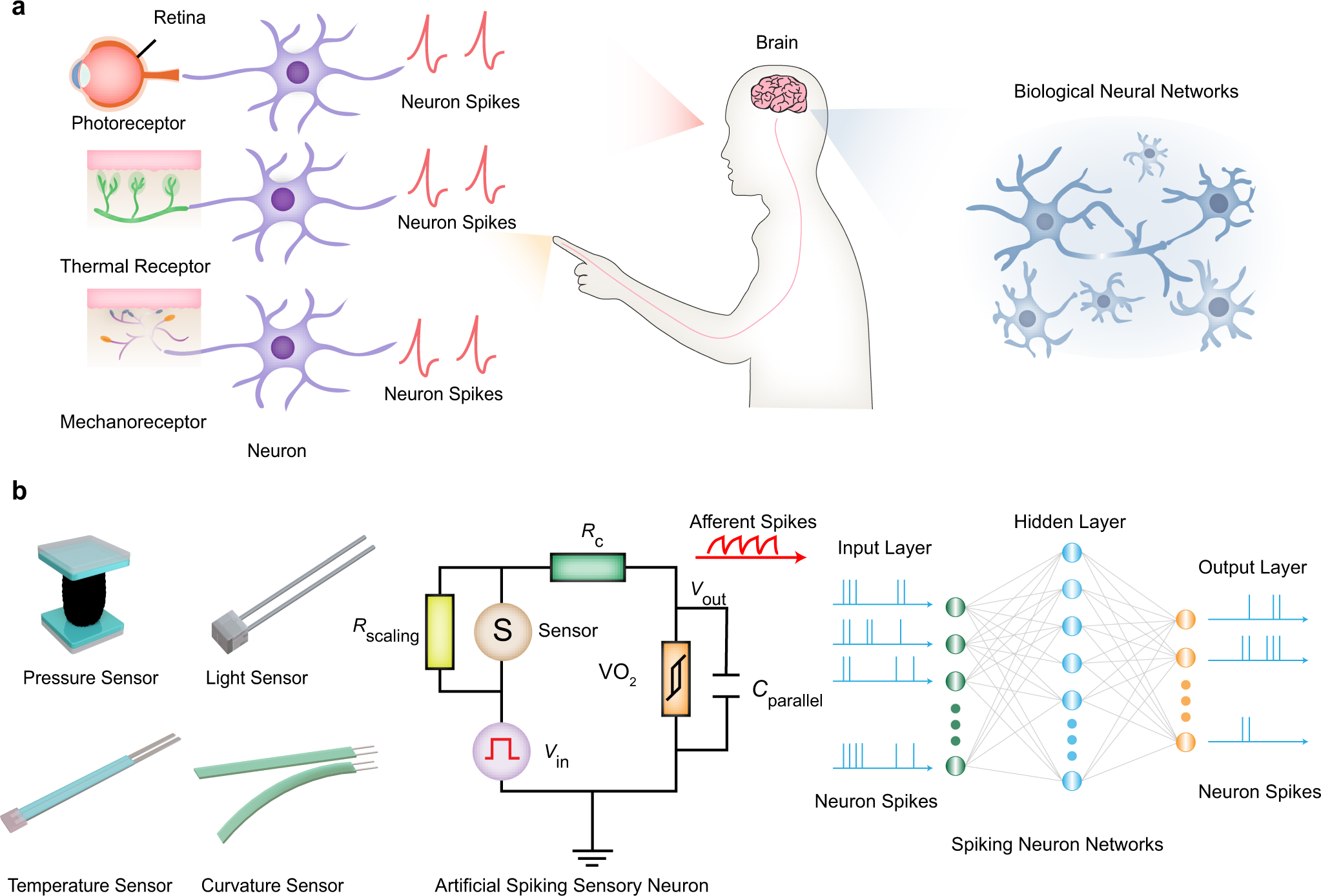
It is real to us, but it may not be what you think you see, compared to other observers.
Hence my relativity question.
Things have an existence independent of any observer, unless that observer (other thing) interacts and influences that which he/she/it is observing.
We always say that we can only describe what we observe and our observations often differ. This does not depend on the object being observed , but on the observer and his relative POV.
The item remains unaffected, unless the observation is at quantum scale where all observations affect the quantum being “observed” (interacted with).
And this is what happens when we study the brain. The act of studying the brain affects the quantum processes in the brain and makes the observation suspect.
As Hoffman proposes, there may be things we can ever know for sure. It may be either too big or too small for reliable data, and we are left with our “best guess”.(Anil Seth)
Yeah, you’ve said all that before
I would find a new philosophy professor. The only separation I can think of is people who have the idea that God is a being and people who see God as an idea.
I can have an idea of what an elephant is, and be wrong. I can be unaware of the differences between African and Indian elephants. Those are beings, different from my idea. But everybody has a different idea of God and none of them can be right because there is no being.
It’s kind of why we have philosophy. So we can talk about these ineffable feelings in a sensible manner. Philosophy that doesn’t ground itself in facts, things that are (i.e. beings), is psuedo-philosophy.
The neuroscience video is really good. Thanks!
Blending that micro view with a somewhat more macro level experiment of split brains might be informative as well. I really enjoyed NOVA’s documentary HERE
BTW, what I get out of watching both videos is that in order to monitor consciousness you need the integrated information (Φ) or perhaps just an EEG.
You cannot count on the individual at all times to inform you of his/her consciousness. The individual can be unaware of consciousness, or perhaps one of an individual’s consciousnesses is unaware of other consciousnesses of the same individual. Perhaps the pronoun, they, applies to each of us.
Or maybe consciousness is pretty meaningless. Consciousness may mean little more than boiling water. A thermometer determines whether water is boiling. An EEG determines whether a brain is conscious. (Granted one is primarily thermal and the other electromagnetic) In other words, consciousness might just be a state of matter. The natural world seems to react to cooling water in pretty much the same way it does to a dying brain.
At this point in time our knowledge base is generating more questions than answers. And of course we might not like the answers once we hold them.
1 Like
Why do you justify discounting photons and pressure waves as direct raw data?
How do you justify disqualifying them as direct sensory signals and raw data?
All sensory information (that is raw data) is received by our sense, processed & converted into electrochemical data that the brain can then assess and process.
There is an unbroken chain of custody from signal, to sensing organs, to the body/brain.
I also notice that you still insist on referring to the brain as an isolated main office or something? As if our brain isn’t intimately wired into every millimeter of our body, meaning the chain of custody between signal and processing is uninterrupted.
That doesn’t answer the why Hoffman question?
With his florid imagination and conceit that if he can imagine it with “rigorous” (though, inscrutable) mathematics, it must be the “truth.” Never recognizing how he’s contrived his parameters to achieve a Truth worked out within the intellectual basketball court of his mindscape, and with a complacent disregard for the lessons that the actual living reality of Earth’s geological/biological evolution provides for scientists and lay enthusiasts.
An aside, notice how besides being unable to write “brain” without including “body/brain” - I can’t write “biological evolution” without adding geology to the equation, since science has taught me the intimate connection between developments in biological evolution, facilitated by geological changes.
Quantum “Conscious agents” doing our thinking for us, an insistence that “truth” is part of evolutionary reality - when truth has nothing do with life outside of our personal human Mindscapes, where we humans assign truth, or ignore truth, as we see fit. In nature it’s not about truth, it’s about learning to work with what we have, and with close enough, being is good enough.
How does that justify invoking Donald Hoffman’s bandwagon and his ludicrous Case Against Reality which is nothing more than a royal M.F.?
The Case Against Reality: [Why Evolution Hid The Truth From Our Eyes (The Case Against Reality | Donald Hoffman | W. W. Norton & Company), by Donald Hoffman, ©2019, W.W.Norton Company
(1.01) The Prelude, Prof Donald Hoffman Playing Basketball In Zero-Gravity(1.02) Chapter 10a, Community: Network of Conscious Agents (1/3)
(1.03) Chapter 10b, Community: Network of Conscious Agents (2/3)
(1.04) Chapter 10c, Community: Network of Hoffmanian Conscious Agents (3/3)
(1.05) Chapter 1, Mystery: The Scalpel That Split Consciousness
(1.06) Chapter 2, Beauty: Siren of the Gene
(1.07) Chapter 3, Reality: Capers of the Unseen Sun
(1.08) Chapter 4, Sensory: Fitness beats Truth
(1.09) Chapter 5, Illusory: The Bluff of the Desktop
(1.10) Chapter 6, Gravity: Spacetime is Doomed
(1.11) Chapter 7, Virtuality: Inflating a Holoworld
(1.12) Chapter 8, Polychromy: Mutations of an Interface
(1.13) Chapter 9, Scrutiny: You Get What You Need, in Both Life and Business
(3.01) Diary - But, wait! There’s more. Ten Learned Responses:
“ Probing the interface theory of perception: Reply to commentaries, by Donald D. Hoffman, Manish Singh & Chetan Prakash"
That’s a very very loosey-goosey description.
But we are influenced by the very space we walk into, before interacting with anything within that space.
Although, aren’t we already interacting, visually, sonically, aromatically and by other more subtle senses?
Some of those very real, if subtle, sensing abilities happen below our chattering consciousness, so “we” aren’t even “aware,” though our body “feels” something.
Your sentence makes no room for all of that.
Which is why I prefer starting with the simple bottom line recognition:
Human Mindscape ~ Physical Reality divide
Then working up from there.
What items remain unaffected by our presence? Rocks and walls and furniture? When it comes to being in the same space with other living creatures, how can you say we humans remain unaffected?
Well that’s the quantum world at the unimaginably small, at the very transition point between “pure” energy and matter. Where thinking does not exist! How do you justify invoking the quantum reality to a discussion about our human animal behavior here on our teaming macroscopic Earth?
Yeah, and as Carl Sagan warned us: Have an open mind, but not so open that your brain falls out!"
Our best guesses only mean something when they can bound off of reality - Hoffman decidedly fails, and it doesn’t need a doctorate to recognize the con-job that man has turned into a veritable cottage industry, thanks to so many people seeking escapism from physical reality these days.